Strategy
How to Build a Pipeline Machine That Compounds
Most B2B companies have a pipeline problem that isn't actually a pipeline problem. It's a funnel problem. They're running one or two stages in isolation, usually outbound and conversion, and wondering why results are unpredictable. The companies generating consistent pipeline aren't doing more outbound. They're running a full funnel where every stage feeds the next one.
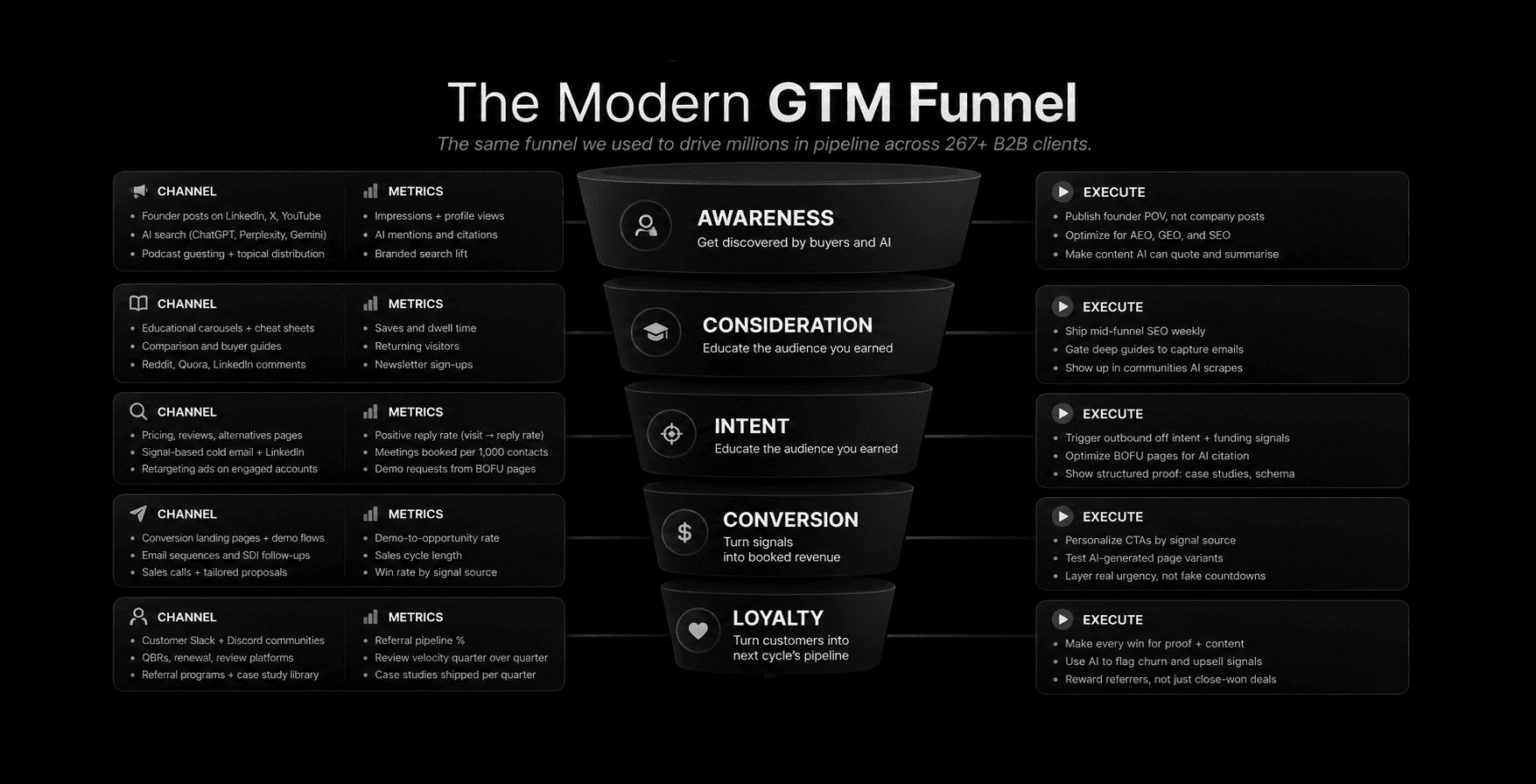
Stage 1: Awareness. Get discovered by buyers and by AI.
The goal at this stage isn't conversion. It's visibility. You want buyers to find you before they're actively looking, and increasingly, you want AI tools to surface you when they are.
The channel that works best here is founder and team content posted daily on LinkedIn, X, and YouTube. Team POV consistently outperforms company page content on every metric worth tracking. Podcast appearances combined with clipped distribution extend the reach further without requiring net new ideas every day.
On the AI side, this is where most B2B companies are asleep at the wheel. When someone opens ChatGPT or Perplexity and types "best B2B GTM agency," you want to show up in that answer. That requires publishing content with structured claims, named numbers, and specific tools called out by name. Content that AI can quote and cite back. This is AEO (Answer Engine Optimization) and GEO (Generative Engine Optimization) alongside traditional SEO, and it's becoming a serious differentiator.
What to track: impressions, profile views, AI mentions and citations, branded search lift.
Stage 2: Consideration. Educate the audience you earned.
This is the stage almost every team underweights. It's also the one that compounds the most over time.
The person who saves your comparison guide in May might not book a call until September. That's not a failure, that's how B2B buying actually works. Awareness gets attention. Consideration earns trust while someone works through their buying process on their own timeline.
The channels that work here are educational carousels, cheat sheets, buyer guides, and comparison pages. Add Reddit, Quora, and LinkedIn comment sections to the mix, because those are places where buyers are already asking questions and you can show up with a real answer instead of a cold pitch.
Gate your deep guides to capture email addresses. Show up in the communities and forums that AI tools scrape for answers. Ship mid funnel SEO content consistently.
What to track: saves, dwell time, returning visitors, newsletter sign ups.
Stage 3: Intent. Catch buyers before they reach out.
By the time someone requests a demo, they've already done most of their evaluation. Intent stage is about identifying who's getting close and reaching them first, before they've made up their mind.
The channels here are signal based outbound through email and LinkedIn, triggered by the signals you're tracking across your prospect list, and retargeting ads aimed at accounts that have already engaged with your content. Add pricing pages, alternatives pages, and review site activity to your signal stack, because those are high intent behaviors that are easy to miss if you're not watching for them.
At this stage, structured proof matters. Case studies, schema markup, and BOFU pages optimized for AI citation all help a buyer justify moving forward when they're close to a decision.
What to track: positive reply rate (not just reply rate), meetings booked per 1,000 contacts, demo requests from bottom of funnel pages.
Stage 4: Conversion. Turn the signal into booked revenue.
This is where most teams focus all of their energy, and it's the stage that benefits the most from everything that came before it. A buyer who discovered you through content, got educated by your guides, and got retargeted before reaching out is a very different conversation than a cold inbound from someone who just found your website.
The channels here are conversion landing pages, demo flows, follow up email sequences, SDR calls, and tailored proposals. Personalize CTAs by signal source so the experience matches how someone got there. Test AI generated page variants. Layer in real urgency without fake countdown timers.
What to track: demo to opportunity rate, sales cycle length, win rate by signal source.
Stage 5: Loyalty. Turn customers into the next cycle's pipeline.
Most companies treat the funnel like it ends at closed won. The best ones treat customers as the top of the next funnel.
Your existing customers are the cheapest and fastest source of referral pipeline, case study content, and expansion revenue you have access to. Most agencies and GTM teams do almost nothing here beyond basic account management. That's the gap.
Build Slack and Discord communities where customers stay engaged after signing. Maintain your presence on review platforms like G2 and Capterra by encouraging happy customers to leave reviews. Build a referral program that rewards people who send you deals, not just customers who close. Use AI to flag churn risk and expansion signals on existing accounts.
What to track: referral pipeline percentage, review velocity quarter over quarter, case studies shipped per quarter, revenue expansion from existing customers.
Why this works better than point solutions
Every stage of this funnel feeds the one below it. Awareness content becomes consideration material. Consideration saves become intent signals. Intent signals become conversion triggers. Happy customers become awareness channels when they refer and review.
Running just one or two stages means you're always starting from zero. A new quarter comes and you go back to cold outbound because there's no warm pipeline sitting in earlier stages waiting to convert.
The full funnel takes time to build. Once it's running, it compounds. Each stage makes the next one cheaper and faster, and the whole system gets stronger every quarter instead of resetting.
That's the actual difference between a growth engine and a pipeline scramble.